
(Picture Source: Gomes, 2020)
Many people think of non-communicable diseases as a high-income nation problem. In other words, a problem caused by over-abundance and indulgence. The data, however, shows that this is in fact an oversimplification. Alcohol abuse, smoking related diseases, diabetes, and mental illness affect all nations. The real differences are in the solutions. Preventive measures must be tailored to the norms and culture of the nation impacted–and, of course approaches will vary according to a country’s income level.
Take the occurence of alcohol abuse or heavy episodic drinking (HED) for example. When it comes to preventing alcohol abuse, we know that prevention strategies should focus on the younger population. The problem is systemic throughout the social and economical stratospheres.
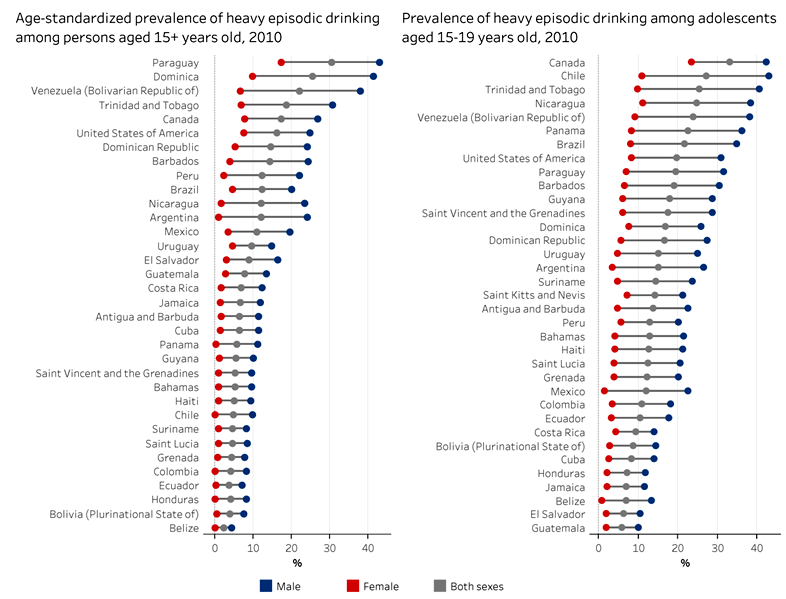
We can look at patterns and differences when trying to design prevention programs. For example, what are the socio-economical differences between Belize, Chile, or Columbia and Paraguay, Dominica, or Venezuela? Are we analyzing the differences in cultural norms that would help explain why HED among 15+ year-olds is so high in this latter countries? And, what about for a narrower population age of 15-19 year-olds? Belize is still low in HED occurrence, but now look at Canada. It shoots up along with Chile (Pan American Health Organization, 2020).
By focusing on these patterns and seeking to answer deeper questions, we can solve for it individually for each country. Getting to the root cause is not easy if we try understand a global problem, well, globally. Countries are unique and we must seek to understand what is happening at a very individual level. Population health is dictated by a country’s unique attributes and identity. We must apply the Five Whys to each country individually if we are to truly design effective solutions.
Source
Pan American Health Organization. (2020). Health status of the population, Noncommunicable diseases prevention and control. Retrieved January 24, 2020, from https://www.paho.org/salud-en-las-americas-2017/?p=1391
CMS. 2020. The five whys tool for root cause analysis. PDF, retrieved from https://www.cms.gov/Medicare/Provider-Enrollment-and-Certification/QAPI/downloads/FiveWhys.pdf
Photo by Giovanna Gomes on Unsplash

 Alexa's Global Health Blog